For many homeowners in Raleigh, Lexington, and across central North Carolina, mature trees are one of the most valuable features of a property. They provide shade, privacy, and curb appeal. But when a tree grows too close to a home, what once felt like an asset can quickly become a structural and financial risk.
A common question we hear at NC Tree Experts is: “Is this tree too close to my house?” The answer depends on species, size, root behavior, soil conditions, and storm exposure — all of which matter in North Carolina’s climate.
If you’re searching for “tree too close to house Raleigh NC,” you’re likely already concerned. Here’s how to determine when proximity becomes a safety issue.
Why Distance Matters More in North Carolina
North Carolina presents unique risk factors that influence safe tree distance:
- Heavy rain that saturates soil
- Clay and compacted residential soils
- Shallow root systems (especially pines)
- Hurricanes and strong seasonal storms
- Mature trees planted decades ago in expanding neighborhoods
In areas like North Raleigh, Wake Forest, Cary, Greensboro, and Lexington, many homes were built near young trees that have since matured beyond safe structural limits. What was once a reasonable planting distance can become dangerous over time.
That’s why understanding structural risk thresholds — not just aesthetics — is critical.
The Fall Radius Rule: A Simple Safety Standard
One of the most important concepts homeowners should understand is fall radius.
A general rule:
If a tree were to fall at full height, could it strike your home?
If the answer is yes, then that tree is within the structural risk zone.
For example:
- A 50-foot pine tree within 50 feet of your home can potentially reach the structure if it falls.
- A leaning tree reduces that safe margin even further.
In Raleigh and Lexington, where storm winds can shift direction suddenly, fall direction is unpredictable. Trees do not always fall “away from” homes as people assume.
When fall radius intersects your roofline, professional evaluation is strongly recommended.
Foundation Risks: Roots and Soil Movement
Tree roots can create issues even before a tree falls.
Common foundation concerns include:
- Soil drying or expansion from root systems
- Cracks forming near foundation walls
- Driveway and walkway lifting
- Basement wall pressure in saturated soils
Certain species, especially large hardwoods and pines, develop wide-spreading root systems. In clay-heavy soils common in Wake County, expanding and contracting soil can amplify pressure on foundations.
If you notice cracks forming or uneven hard surfaces near a large tree, a structural risk assessment may be necessary. In some cases, the safest solution becomes professional tree removal before structural damage worsens.
Roofline and Limb Overhang Risks
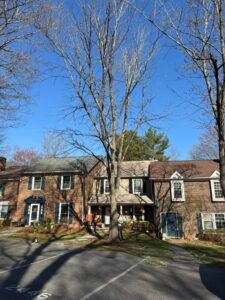
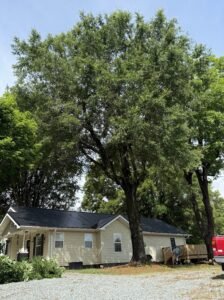
Even if the trunk seems far enough away, limbs may extend directly over the home.
This creates multiple hazards:
- Falling limbs during storms
- Constant roof abrasion
- Gutter damage
- Increased moisture retention and mold risk
While strategic tree trimming can reduce minor overhang, trimming is not always enough if the tree’s overall structure is compromised.
If large limbs hang directly above living spaces, that risk should not be ignored — especially before hurricane season.
When Proximity Becomes a Removal Issue
Not every tree near a home needs to be removed. However, removal becomes a serious consideration when:
- The tree is within full fall radius of the home
- The tree leans toward the structure
- Roots are visibly lifting or destabilizing soil
- The trunk shows decay or cracking
- Multiple large limbs extend over the roof
- The tree has storm damage history
In high-density areas of North Raleigh and established neighborhoods in Lexington, space limitations often mean trees simply outgrow safe distances.
In those cases, proactive tree removal is often safer and more cost-effective than waiting for a failure.
Insurance Considerations: What Homeowners Should Know
Many homeowners assume insurance will handle everything if a tree falls. That is often not the case.
Insurance typically:
- Covers structural damage after impact
- May limit debris removal coverage
- Does not cover preventative removal
If a tree is visibly hazardous and left unaddressed, insurers may argue negligence contributed to damage.
Addressing a tree that is too close to your home before failure can protect both your structure and your financial exposure.
If you’re unsure how proximity affects your specific situation, the team at NC Tree Experts can help you assess risk and determine next steps. You can schedule an evaluation through the contact page.
Storm Exposure Increases Risk
Distance becomes even more critical during storm season.
In central North Carolina, heavy rain weakens soil grip. High winds increase canopy pressure. Trees that might appear stable under calm conditions can fail quickly during storms.
When homes in Raleigh, Greensboro, Winston-Salem, or Wake County cities experience repeated storm exposure, trees within fall radius deserve careful evaluation.
After severe weather, some homeowners require immediate emergency tree service due to trees partially uprooted or leaning toward homes.
Proactive removal is often far less expensive than emergency stabilization and repair.
Real Estate Transactions and Safe Tree Distance
If you are selling a home in Lexington or Raleigh, trees too close to the structure often appear in inspection reports.
Inspectors frequently flag:
- Trees touching roofs
- Large trees within close proximity
- Visible root intrusion
- Leaning trees
These findings can:
- Delay closing
- Trigger buyer repair requests
- Affect lender approval
- Create insurance binding issues
Addressing proximity concerns before listing can help avoid last-minute complications.
How Professionals Evaluate Safe Distance
At NC Tree Experts, evaluating whether a tree is too close involves more than measuring feet from the house.
Professional assessments consider:
- Species type
- Mature height potential
- Root spread patterns
- Soil conditions
- Structural lean
- Wind exposure
- History of storm damage
A 20-foot ornamental tree may pose little risk 15 feet from a home. A 70-foot pine in the same position is a different situation entirely.
Local expertise matters. Conditions in Wake County differ from Greensboro or Winston-Salem due to soil variation and neighborhood density.
Warning Signs You Should Not Ignore
If a tree near your home shows any of the following signs, proximity becomes more concerning:
- Sudden leaning after rain
- Soil cracking or lifting
- Dead upper canopy sections
- Fungal growth at the base
- Cracks in the trunk
- Large limbs breaking off during minor storms
These signals suggest structural instability — not just inconvenience.
When Trimming Is Enough — and When It Isn’t
Strategic trimming can:
- Reduce limb overhang
- Remove weak branches
- Improve structural balance
But trimming cannot:
- Correct root instability
- Fix soil movement
- Reverse trunk decay
- Change fall radius
If the primary concern is full structural impact potential, trimming alone may only delay a larger issue.
The Cost of Waiting
Homeowners often delay removal because the tree “looks healthy.” But structural failures in North Carolina frequently occur due to environmental conditions rather than visible disease.
Waiting can lead to:
- Roof replacement costs
- Foundation repairs
- Driveway reconstruction
- Insurance disputes
- Emergency removal fees
In many cases, addressing a high-risk tree proactively is the safer financial decision.
Making the Right Call for Your Property
Every property is different. What is safe in one yard may be dangerous in another.
If you’re questioning whether a tree is too close to your home in Raleigh, Lexington, North Raleigh, Greensboro, Winston-Salem, or surrounding Wake County areas, a professional evaluation provides clarity.
NC Tree Experts specializes in identifying structural risk thresholds and recommending responsible solutions — whether that means trimming, monitoring, or complete removal.
When safety and your home’s structural integrity are on the line, distance matters.